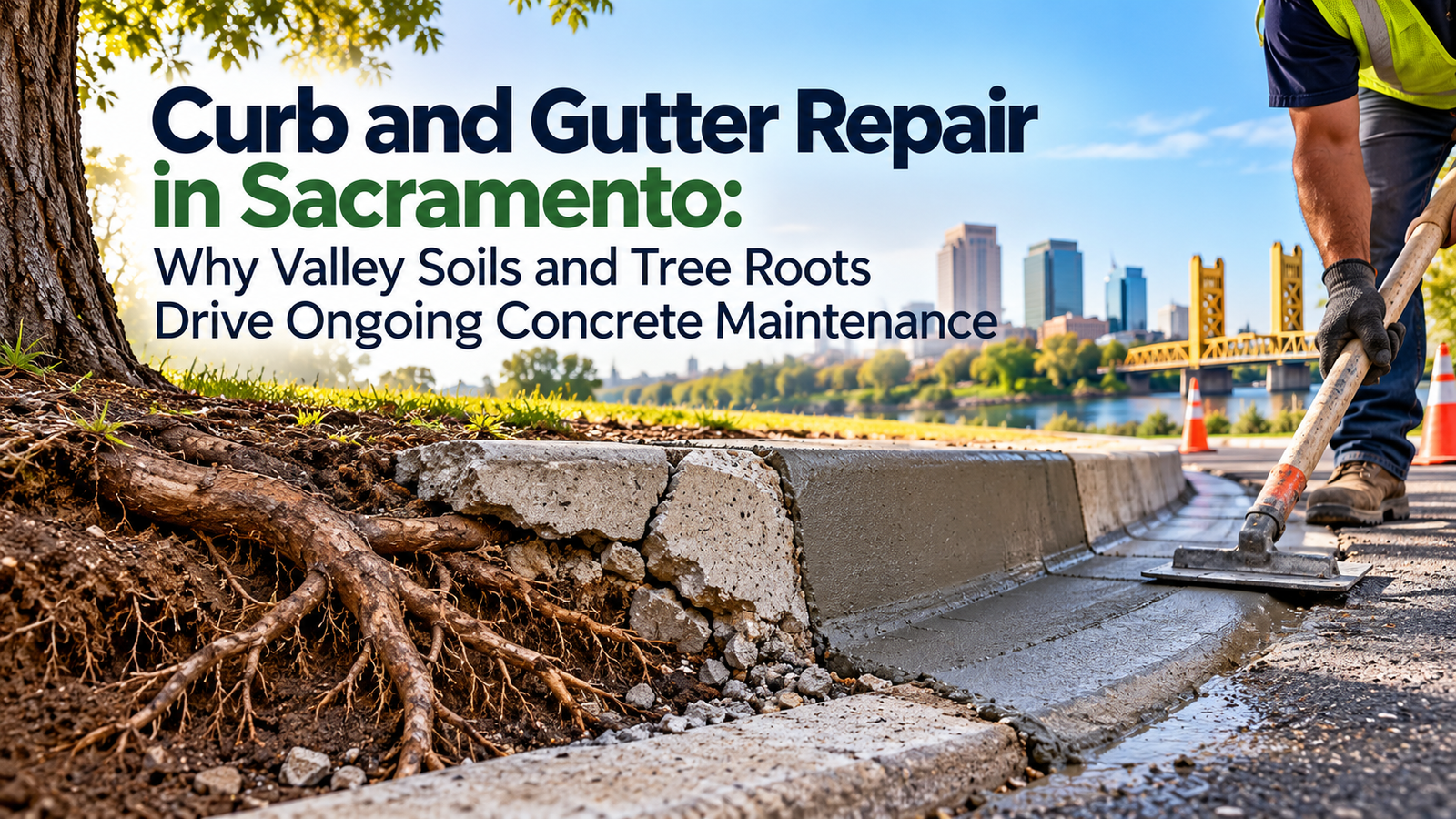
Curbs and gutters are the linear concrete structures that define the edge of the roadway, manage surface drainage, and separate the paved travel surface from adjacent pedestrian and landscape areas. In Sacramento, curb and gutter failures are among the most common concrete maintenance issues in both public rights-of-way and private commercial properties. The Sacramento Valley’s combination of expansive clay soils, a mature urban tree canopy with aggressive root systems, and the hot dry climate that drives concrete shrinkage and cracking creates conditions that produce Curb And Gutter Repair Sacramento damage at rates well above national averages.
Understanding what causes curb and gutter failure in Sacramento, what proper repair involves, and what standards govern curb and gutter construction in the region helps property owners, developers, and contractors approach this maintenance issue systematically rather than reactively addressing the root causes of failure rather than patching symptoms that will recur without proper remediation.
The Most Common Causes of Curb and Gutter Failure in Sacramento
Tree root intrusion is the dominant cause of curb and gutter failure throughout Sacramento’s established neighborhoods. The city’s urban tree canopy one of the largest and most celebrated in the United States, with an estimated 170,000 street trees is largely composed of species with aggressive lateral root systems. Large-caliper valley oaks, London plane trees, silver maples, and Chinese elms grow roots that travel beneath curb and gutter sections, exerting upward pressure that lifts the concrete, cracks it at joints, and creates the uneven surface lips that are a common pedestrian hazard in Sacramento neighborhoods.
Vertisol clay subgrade movement is the second major cause. Sacramento’s native soils shrink when dry and expand when wet, cycling through this volume change with each seasonal moisture cycle. Curb and gutter founded on these soils without adequate subbase aggregate separation follows the soil movement, heaving upward in wet seasons and settling in dry conditions. This cycling cracks the concrete at its weakest points typically at the joints and at the transition to adjacent pavement and progressively degrades the structural integrity of the section.
Deferred joint maintenance allows water infiltration into curb and gutter joints, accelerating both root intrusion and soil moisture cycling. Joint sealant that has cracked or failed creates an open pathway for water to enter the subbase, for tree roots to follow that water source, and for freeze-thaw action to widen the opening with each winter cycle. Maintaining joint sealant as part of a routine maintenance program significantly extends curb and gutter service life.
Public Right-of-Way Standards vs. Private Property Curb and Gutter
Curb and gutter repair in the City of Sacramento public right-of-way the street edge and sidewalk area maintained by the city must meet City of Sacramento Standard Specifications for Public Works Construction (the city’s “Green Book” standards). These specifications govern concrete mix design, curing requirements, joint spacing, reinforcement, and compaction of the subbase.
Sacramento Municipal Code Section 20.08 addresses the responsibility for curb, gutter, and sidewalk repair adjacent to private properties. In Sacramento, the property owner is responsible for maintaining the sidewalk fronting their property and, in many cases, for repairing curb and gutter damage caused by street trees planted by the city. The city’s Urban Forestry program addresses street tree root damage to curb and gutter in priority order, but the timeline for city-funded repair may be longer than a property owner’s needs, and many owners choose to fund repairs independently to address safety hazards promptly.
Private commercial properties shopping centers, office parks, industrial facilities maintain their own internal drive aisles, parking lot perimeters, and curb and gutter systems as private infrastructure. These repairs follow industry standard practice rather than city specifications, though they must meet ADA requirements for accessible routes where applicable.
What Curb and Gutter Repair Actually Involves
Curb and gutter repair begins with removing the failed section. Saw cutting at the limits of the repair typically at existing joints or at cut lines that avoid damage to adjacent sections defines the removal boundary. The hydraulic breaker fractures the concrete within the cut lines, and the broken material is removed and hauled to a concrete recycling facility.
After removal, the subbase is inspected. If root systems are present, they are removed as completely as practical within the repair area. Physical root barriers typically impermeable geomembrane sheets installed vertically in the ground to the depth of the root zone are placed at the excavation boundary to redirect future root growth away from the new concrete section. Without root barriers, tree root intrusion will recur at the same location.
Aggregate base material is placed and compacted in the bottom of the excavation to the specified depth typically four to six inches for curb and gutter applications. The forms for the new curb and gutter section are set to the correct grade and alignment using string line or laser level. Concrete is placed, consolidated by vibration, and finished to match the adjacent sections. Curing compound is applied to the fresh concrete surface to retain moisture during the critical early curing period.
Sacramento’s Heat and Concrete Curing
Sacramento’s hot, dry summer climate creates challenging conditions for concrete curing. When ambient temperatures exceed 90 degrees Fahrenheit and wind is present, fresh concrete can lose moisture to evaporation at rates that cause plastic shrinkage cracking within an hour of placement. The American Concrete Institute’s guidelines for hot weather concreting specify precautionary measures including pre-wetting subbase and forms, using cooled mix water, scheduling pours during cooler parts of the day, and applying curing compounds or wet burlap and plastic sheeting immediately after finishing.
Summertime curb and gutter repair in Sacramento requires these hot weather practices. Contractors who ignore hot weather protocols produce concrete with surface cracking that allows immediate water and root infiltration, undermining the repair from the first rain season after installation. Properly cured concrete achieves the design strength and durability that justifies the investment in the repair.
ADA Compliance and Curb Ramp Requirements
Curb and gutter repair that occurs at or near pedestrian crossing points intersections, mid-block crossings, and driveway approaches triggers ADA accessibility requirements for curb ramps. Under California Title 24 and the federal ADA Standards for Accessible Design, curb ramps must meet specific slope, width, and cross-slope requirements that allow wheelchair users and others with mobility impairments to transition between the street and the sidewalk safely.
When curb and gutter repair involves reconstruction at a pedestrian crossing, the repair scope must include updating the curb ramp to current ADA standards. The “nexus” principle under California accessibility law requires that accessibility improvements accompany alterations to the public right-of-way when the alteration triggers accessibility obligations. Property owners who repair curb and gutter without updating adjacent non-compliant curb ramps may face code enforcement action.
Frequently Asked Questions: Curb and Gutter Repair in Sacramento
Why do Sacramento street trees cause so much curb and gutter damage?
The city’s large-caliper street trees have lateral root systems that extend under curb and gutter sections seeking moisture at joints and beneath the concrete. The root growth exerts upward pressure that lifts and cracks the concrete, particularly in species with shallow, aggressive lateral root systems like silver maple and Chinese elm.
Who is responsible for curb and gutter repair in Sacramento’s public right-of-way?
Property owners are generally responsible for sidewalk maintenance adjacent to their property under Sacramento Municipal Code Section 20.08. Curb and gutter damage from city-planted street trees may qualify for city repair programs, though processing timelines vary.
Do root barriers work for preventing recurrence of curb damage?
Yes, when properly installed. Impermeable root barriers installed vertically to the depth of the root zone at the repair boundary redirect future root growth. Without barriers, tree root intrusion will recur at the same location within a few years.
What are the hot weather concreting requirements for Sacramento repairs?
ACI hot weather guidelines apply when temperatures exceed 90 degrees. Pre-wetting forms and subbase, scheduling pours in cooler hours, using cooled mix water, and applying curing compound immediately after finishing prevent plastic shrinkage cracking in Sacramento’s summer climate.
Does curb repair near pedestrian crossings require ADA updates?
Yes. California and federal accessibility law requires that curb ramps be updated to current ADA standards when curb and gutter alterations occur at or near pedestrian crossing points. Repairs that omit this update create accessibility compliance exposure.
Curb and gutter repair in Sacramento addresses a persistent maintenance challenge driven by the city’s celebrated tree canopy, its expansive clay soils, and a hot dry climate that is hard on concrete. Professional repair that addresses root systems, installs root barriers, meets hot weather concreting requirements, and complies with ADA standards produces results that last rather than temporary fixes that reproduce the same failures in the next rain season.